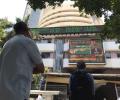
Investor wealth slumped by Rs 3.7 lakh crore on Monday, as the equity market recorded its biggest single-day fall in two months.

The benchmark index of the Bombay Stock Exchange climbed above 17,000 points on Wednesday for the first time since May 2008.

After his previous visit, the Sensex crashed and it took four painful years to top the 21,000 mark.
National Stock Exchange decided to waive off transaction charges on trades done on its new mini-Nifty, till March 31.
BSE small-cap index, which ended over 1% higher, outperformed the benchmarks significantly.
Both equity benchmarks--the Sensex of the Bombay Stock Exchange and the Nifty of the National Stock Exchange-- have gained 14 per cent and 12 per cent, respectively, as the USDX rose by a quick 7.83 per cent in over a month. It touched a high of 77.50 on August 26.
BHEL, YES Bank, RCom, Titan Ind, JP Associates, BF Utilities, Ruchi Soya and Punj Lloyd have tanked more than 10% each on BSE.

Market benchmarks gave up intra-day gains to close in the red for the sixth session on the trot on Friday, capping a bruising week which saw a massive dash for safety amid rate hikes by global central banks and fears of slowing growth.

The Bombay Stock Exchange, the oldest bourse in Asia, is looking at listing its benchmark 30-share index Sensex on the US-based International Securities Exchange that is owned by Eurex Frankfurt AG.

Falling for the sixth straight session, the BSE Sensex plunged 1,114.82 points or 2.96 per cent to close at 36,553.60 on Thursday, tracking a heavy selloff in global markets. The market capitalisation of BSE-listed companies stood at Rs 1,48,76,217.22 crore, down by Rs 11,31,815.5 crore in six sessions. Since September 16, the 30-share BSE benchmark index has fallen by 2,749.25 points.
The Bombay Stock Exchange (BSE) planned to list the futures trading in its benchmark index, Sensex.

Analysts suggest investors remain in a wait-and-watch mode and not jump in to buy stocks across-the-board.

From the enactment of the capital control Act to the recognition of the BSE as a stock exchange and the infamous Harshad Mehta scam, here are the 18 biggest events for stock markets from 1947 to 1993.
Markets are neither bullish nor bearish. They always reflect some fundamental or technical reality.
Tech results are supposed to be lack lustre, says market expert Pranav Sanghavi.

Realised volatility is a measure of actual price volatility, based on past price movements over a specific period of time.
The Bombay Stock Exchange benchmark Sensex has declined 17 per cent in this calendar year and has underperformed the US and European markets.

The country, last year, stood at the 27th spot for effective regulation and supervision of securities exchanges.
Of the 450 stocks, 243 stocks -- mostly small- and mid-caps -- touched their 52-week highs on Tuesday. Both the Sensex and Nifty ended the day with declines of 0.34 and 0.24 per cent respectively.
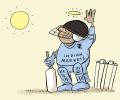
With the markets scaling new highs, as many as 43 stocks from the Nifty50 index and 27 of the 30 scrips that are part of the S&P BSE Sensex are trading above their respective 200-day moving average (DMA). The 200-DMA is seen as one of the most relevant trend indicators by investors and traders, who believe that stocks and indices trading above this level possess strength and are likely to rally in the short to medium term, while the ones trading below this level are viewed as bearish and expected to see a sell-off. Wipro, UPL, Kotak Mahindra Bank, Hindalco, Infosys, Cipla, and Adani Enterprises are the only stocks from the Nifty50 pack that are still below their respective 200-DMA, the exchange data suggests.
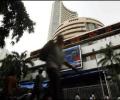

Without naming Adani group specifically, the capital markets watchdog said in a statement that unusual price movement in the stocks of a business conglomerate has been observed in the past week.

Extending its losing streak for the third consecutive session, energy major Reliance Industries fell by 1.6 per cent on the Bombay Stock Exchange on Thursday, dragging the broader Sensex down by 80.71 points.
The 30-share Bombay Stock Exchange BSE Sensex closed almost 330 points higher at 21,326 levels after hitting an all-time intra-day high of 21,484 during the day and the 50-share Nifty closed at its all-time high of 6,363.90, up almost 100 points.
Which fund companies' equity funds clocked the best median performance over a five-year period? Here's the answer!
R Com has and will continue to surprise the markets on a positive note, says stock market expert Madhusudan Sarda.
It was the worst Budget day today for Dalal Street with the Bombay Stock Exchange index Sensex plunging over 850 points - the biggest fall on any Budget day - on concerns of widening fiscal deficit.

Sensex valuation has fallen below historical averages, now lags underlying earnings & dividend growth.

Oil companies, cement makers, IT stocks lead declines.

After a disastrous 2011, stock market investors are pinning hopes on next year. Top sell-side analysts believe though there is more pain ahead, 2012 is likely to end on a positive note.
Indian shares may not be able to build solid gains on last week's relief rally as concerns surrounding slowing growth in Asia's third-largest economy and lingering worries over euro zone debt crisis will continue to temper investors' enthusiasm.
"We will complete the transformation within May 2007 and are talking to select foreign exchanges for a possible partnership," Bombay Stock Exchange Ltd managing director and CEO Rajnikant Patel said.
In May, MFs were the net sellers in several PSUs, as they deployed Rs 47,600 crore in equities during the month.

The NSE Nifty ended with a gain of 113 points at 6143.
.jpg)
Initial data for the Sensex was not available because of the glitch.
The good part is that even in the most beaten down sectors, there have been some select stocks that have given not just positive, but considerable, returns.
